

In the grid below, box A shares walls or corners with 3 other boxes, B, E, and F. Determine how many walls or corners each of the other boxes share.

Solution
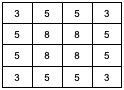
What would the numbers be in a 5 x 5 grid?
October 2026 - Problem of the Month
At Doggy Daycare, there is one dog for every bowl of food, two dogs for every bowl of water, and three dogs for every bowl of treats. Every dog gets a serving of food, water and treats.
If there are a total of 77 bowls, how many dogs are there?
Solutions will be posted at the end of the month!
September 2026 - Problem of the Month
Four players had a Tic-Tac-Toe tournament.
Each player played every other player only once.
No player lost all of their games, and there were no ties.
Anna and Desi each won two games.
How many games did each of Ben and Chin win?
Give it a try!
Solution
With four players, there are 6 games:
AB, AC, AD, BC, BD, and CD.
If Anna and Desi each won 2 games, then Ben and Chin won the remaining 2 games combined.
Problem of the Month - June 2026
Look at the following row of numbers:
10, 15, 21, 4, 5
They are arranged so that each pair of adjacent numbers adds up to a square number:
10+15=25
15+21=36
21+4=25
4+5=9
Can you arrange the numbers 1 to 17 in a row in the same way, so that each adjacent pair adds up to a square number?
Source: NRICH
Problem of the Month - April 2026
Pick any 3 numbers from the following list, circle them, and find their sum
1 , 1 , 1 , 4 ,4 , 4, 7 , 7 , 7, 10, 10 ,10
Repeat the process with a new set of numbers from the original list.
What do you notice about the sums?
Can you explain why this happens?
Answer:
The sum is always a multiple of 3.
Problem of the Month - May 2026
Each number from 1 to 6 replaces one of the letters P, Q, R, S, T, and U.
The sum of P and Q is 5 and the difference between R and S is 5.
If T is greater than U, what number replaces the letter T?
Source: 2023 Gauss Math Contest
Answer:
Since the sum of P and Q is 5, P and Q must be 1 and 4 or 2 and 3.
Since the difference between R and S is 5, R and S must be 1 and 6.
This means that P and Q must be 2 and 3.