

A Question of Scale
I will be able to…
✔ compare powers of ten
✔ consider where powers of ten are used in everyday life
✔ compare very large and very small numbers in everyday life contexts
Instructions: These activities will test your knowledge of powers of 10 in scientific contexts. Will you be able to judge the length of the physical objects, with sizes ranging from 1 Angstrom to 1 million km? The cards presented have been jumbled up.

Can you match them to the correct order of magnitude?
Follow the link to try the online activity: https://nrich.maths.org/6349
Reflection:
Are there any objects in the list whose size I am fairly sure about?
Is this object bigger or smaller than that one? How many times bigger or smaller?
You may be interested in watching this follow up video: The Metre - Metric unit of length
Factors & Multiples
I will be able to ...
✔ identify the factors of various whole numbers.
✔ identify the multiples of various whole numbers
Instructions:
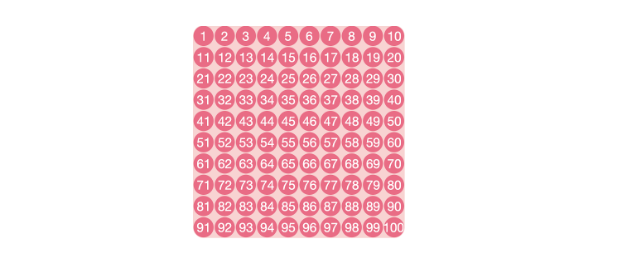
- This is a game that can be played with one or two players. You will need either a 50 square grid, a 100 square grid, or cards numbered 1 to 100.
- Two player rules: The first player chooses a positive even number that is less than 50, and crosses it out on the grid. The second player chooses a number to cross out. The number must be a factor or multiple of the first number. Players continue to take turns to cross out numbers, at each stage choosing a number that is a factor or multiple of the number just crossed out by the other player. The first person who is unable to cross out a number loses.
- One player rules: Try to make the longest chain using factors and multiples on your own.
- Follow the link to use an interactive version for one or two players: https://nrich.maths.org/factmult/
Reflection:
Do you have a winning strategy?
Are there any numbers you should try to avoid?
Seven Squares
I will be able to…
✔ describe different patterns seen in a given representation
✔ make predictions using these patterns
✔ justify my thinking
Instructions:
Three students were asked to draw this matchstick pattern:

Watch the videos posted by nrich at: https://nrich.maths.org/sevensquares
Describe what each of the students did to recreate the image. Using each student’s strategy, describe how they would create the 25th and 100th terms in the pattern. How many matchsticks would be used in each case?
Reflection:
How would you count the matchsticks differently in each situation?
Choose one of the final patterns presented. Predict how to make the next few terms.
Use your method to determine the number of matchsticks for the 25th, 100th and nth term in the pattern.