
The York Region District School Board has policies, procedures and guidelines in place that provide strong foundations for an equitable and inclusive workplace and learning environment. Ontario's Equity and Inclusive Education Strategy provides the foundation for the work in school boards regarding equitable and inclusive practices in support of student achievement and well-being. York Region District School Board is a recognized leader in equity and inclusivity through its multifaceted initiatives, programs, and activities, supported by Equity and Inclusivity policies and procedures that advance its goal of inclusion.
Status Report December 2025
The Learning Together Symposium took place on November 19th, 2025 for school and central teams district wide. This year’s Symposium focused on supporting YRDSB staff in developing strategies for student achievement, creating positive relationships to promote mattering and belonging, and deepening the understanding and practice of human rights and inclusivity. Schools were represented by teams of educators, including school administrators, Equity Designates, Indigenous Education Liaisons and curriculum leads. Service departments were represented by managers and staff who have volunteered to take on the role of Equity Designates and Indigenous Education Liaisons.
Keynote presentation included Kevin Ko on AI’s Journey from Pop Culture to Personalized Learning. Symposium participants engaged in focused learning in the following sessions grounded in Multi-Year Strategic Plan and District Action Plan three priorities on Student Achievement, Health and Well-Being, and Human Rights and Inclusive Education:
- Beyond the Book List: Using the Text Selection Tool to Make Decisions about Classroom Texts
- Leading Math Learning in Your School
- Moving Beyond One Solution: Inclusive Problem Solving in Math
- Transforming Teaching and Learning Through the Use of Artificial Intelligence
- What’s Writing Got to Do with Early Reading Screening?
- Attendance Matters: Building a Culture of Belonging and Engagement to Support Student Succes
- Playful Learning in Action.

The Inclusive School and Community Services (ISCS) department is dedicated to supporting the board’s commitment to achieving equitable outcomes for marginalized students by championing equity and inclusivity as foundational to student achievement and well-being. ISCS is comprised of the following teams: the Community and Partnership Developers, Equity and Inclusive Education Consultants, Dismantling Anti-Black Racism Strategy Implementation Plan Team, First Nations, Métis and Inuit Education Team and YRDSB’s Reception Centre. These teams work intra-and-interdepartmentally to lead and support the implementation of the Multi-Year Strategic Plan, the District Action Plan, the board’s Equity and Inclusive Education Policy and Procedures, the Indigenous Education and Equity Strategy, and the Dismantling Anti-Black Racism Strategy.
ISCS staff engage in a wide range of actions at the system, school and classroom levels and provide identity-affirming, culturally responsive services and supports for equity-deserving communities. ISCS works in partnership with a wide range of community partners to identify and remove barriers and work collectively to ensure equitable outcomes and inclusive schooling experiences for all students.
The Inclusive School and Community Services (ISCS) department collaborates with a variety of community partners to identify and eliminate barriers, working together to provide equitable opportunities and inclusive educational experiences for all students. Key system actions include:
- Professional Learning Communities: The First Nations, Métis, and Inuit Education Team provided professional learning to 436 staff and 202 administrators. Some of the key opportunities included:
- NBE (Grade 11 English) Listening Tours
- Anti-Indigenous Racism and Indigenous Pedagogies
- Exploring Literacy Through Cultural Text Forms Project
- Grade 7/8 Interrelationships in History, Geography, and Environmental Education
- Elevating First Nations, Métis, and Inuit Perspectives in Grade 9 Geography
- Grade 1–3 Interrelationships
Additionally, Indigenous Student Advisors supported 108 students and families, 47 schools, and engaged 300+ community members in cultural events during 2024–2025. Advisors provided academic guidance and cultural engagement, working closely with students, families, and communities to ensure success and belonging.
- Community Circles and Restorative Practices: For the 2024-25 school year, the Caring and Safe Schools Department offered professional learning to over 300 elementary and secondary educators on Community Circles and Restorative Practices. Professional learning helps educators intentionally create caring, safe, and inclusive learning environments using community circles and other intentional community-building activities. Educators also learned to respond to student behaviour with restorative conversations, small-group and whole-class restorative circles.
- YRDSB Bias-Aware and Trauma-Informed Progressive Discipline Continuum: To support the Dismantling Anti-Black Racism Strategy (DABRS) and reduce the disproportionate use of punitive discipline against Black students, Caring and Safe Schools provided professional learning for 150 school administrators on integrating restorative practices into the YRDSB Bias-Aware and Trauma-Informed Progressive Discipline Continuum. As a result of attending the professional education, administrators shared through a feedback survey a shift in mindset from using solely punitive practices to considering the use of more corrective interventions and support in response to inappropriate student behaviour.
- Impact of Programs for Black Students: Throughout 2024-2025, the following programs were implemented: Graduation Coaches, Camp Black Brilliance (CBB), the Y2 LEGACY Program, and the DABRS Credit Attainment Program. These programs positively impacted Black students across the system. For example, the Graduation Coaches for Black Students program provides culturally responsive supports to Black students to help achieve their academic goals, strengthen confidence and motivation to attend and graduate from school, and connect students with resources. In 2024-2025, there were four Graduation Coaches who supported 225 Black students in Grades 9-12 across all 33 secondary schools. YRDSB also provided credit attainment support to Black students through an intentional, identity-affirming approach. The program created learning environments for students to thrive, allowing many to earn new credits and recover credits they had previously not completed successfully. During the summer, 96% of 27 students attained or recovered credits.
- Inclusive School and Community Services (ISCS) Consultants: In 2024–2025, YRDSB strengthened its commitment to equity and inclusion by providing consistent, system-wide access to Equity and Inclusive Education supports. Consultants delivered scheduled, in-school professional learning for both elementary and secondary schools, focusing on inclusive planning, instructional strategies, and assessment practices aligned with each school’s improvement plan. This work advanced human rights principles by fostering learning environments that reflect student identity, lived experience, and systemic barriers. It also reinforced inclusive practices that promote belonging, well-being, and academic success. By embedding equity into daily teaching, assessment, and school improvement processes, these efforts created conditions for improved student outcomes. Throughout the year, administrators, teachers, and Supervisory Officers shared positive feedback, noting the consistency, accessibility, and relevance of the support and its value in sustaining schools’ equity and inclusion initiatives.
- Inclusive Education Professional Learning and Affinity Group Engagement: In 2024–2025, YRDSB advanced its commitment to human rights and inclusive education by delivering system-wide professional learning and affinity group engagement opportunities that supported educator understanding of diverse identities and experiences. Through a range of learning sessions, educators deepened their capacity to recognize and address identity-based discrimination and harm, and to foster inclusive, affirming, and respectful learning environments for students and families. This work strengthened inclusive instructional practices, supported student well-being and belonging, and contributed to improved conditions for student achievement across schools. Affinity group-led learning and community engagement further elevated community voice, strengthened relationships with families and reinforced culturally responsive and identity-affirming practices. Collectively, these efforts supported schools in building inclusive environments that reflect student identity, lived experience, and systemic barriers, while sustaining a shared commitment to equity and inclusion across the system.
Examples of professional learning provided to the system were:
- Addressing Antisemitism Professional Learning
- Addressing Islamophobia Professional Learning
- YRDSB Learning Together Symposium
- Inclusive Education: Secondary Educator P.A. Day Learning
- Affirming Sikh Identities Educator Workshop
- Spring Learning Series: Centring Students and Supporting Achievement
- Inclusive Education: Elementary and Secondary Workshop for Resource Review
- Supporting Jewish Students: Building Inclusive Classrooms
- Teaching the Diversity of Identity through Periphery
- The Power of PRIDE: Educator Strategies to Support 2SLGBTQIA+ Students
Examples of Affinity Group learning opportunities were:
- Educator Workshop led by the Network of Educators for Korean Canadian Students (NEKS)
- Islamic Heritage Month Family Engagement events
- Tamil Family and Tamil Heritage Month events
- Sikh Educators Voice Alliance (SEVA) Gurupurab and Langar Celebration
- Supporting East Asian Students (SEAS) Family Engagement Event Series
- Persian Heritage Month events
- Jewish Heritage Month events
- South Asian Heritage Month events
The York Region District School Board (YRDSB) continues its commitment to achieve racial equity for Black students and staff through the Dismantling Anti-Black Racism Strategy (DABRS), a five-year initiative.
The DABRS aims to achieve racial equity in YRDSB schools and workplaces for Black students and staff. It focuses on:
- Creating Black-affirming learning and working environments;
- Interrupting and addressing anti-Black racism by removing systemic barriers and discriminatory practices; and
- Improving outcomes for Black students and staff.
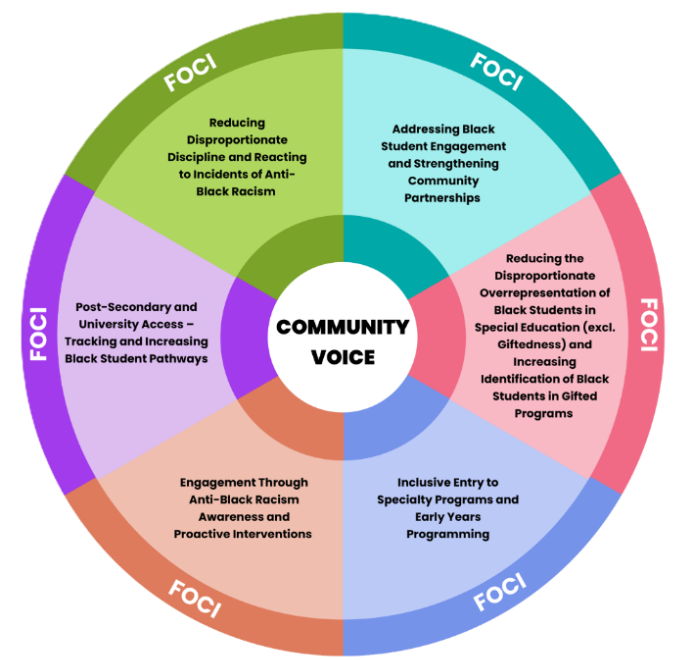
The DABRS implementation framework reflects the continued balance of working towards dismantling systemic barriers while offering specific programs to support Black students. Strategy implementation remains grounded in the concerns of the community and driven by data (student outcomes and perceptions). Transformational shifts included the introduction of Focus on Continuous Improvement (FOCI) areas to guide the work of the seven DABRS priorities. The strategy includes a robust accountability framework to monitor progress and ensure transparency. Work within each FOCI area is a collaboration between members of the FOCI group (Superintendents, administrators, educators, ISCS consultants etc.).
There are six Focus on Continuous Improvement (FOCI) areas that guide the implementation of the DABRS. Work within each FOCI area is a collaboration between members of the FOCI group. This section provides a high-level summary of the actions implemented during Year 4 by FOCI area.
Figure: Year 4 FOCI areas informed by community voice
Goals of each Foci group and key system actions include:
1. Addressing Black Student Engagement and Strengthening Community Partnerships
Goal: To strengthen culturally responsive support systems that foster Black student engagement and success, while expanding meaningful partnerships with Black families and communities to enhance student outcomes.
Year 4 Actions: YRDSB supported Black students’ success through identity-affirming programs such as the DABRS Credit Attainment Program, the Y2 LEGACY Program and Camp Black Brilliance (CBB). Y2 LEGACY leveraged a partnership with York University to offer Black students a credit-bearing course, and a partnership with a Black-led community organization to offer a mentorship opportunity for a co-op student during its’ summer camp. CBB intentionally involved parents, caregivers, and community partners as active participants, reinforcing collaborative support for student success.
2. Reducing Disproportionalities of Black Students with Special Education Needs (excluding Giftedness) and Increasing Giftedness Identification
Goal: To examine current practices that contribute to the overrepresentation of Black students in special education (excluding giftedness) and to promote more equitable identification of Black students for gifted programming.
Year 4 Actions: An interdepartmental team reviewed data on educational identifications, placements, and programs in special education. In response to the underrepresentation of Black students identified with Giftedness , the research and implementation plans were developed to pilot the Naglieri General Abilities Test as part of stage one of the gifted screening process in the next school year.
3. Inclusive Entry to Specialty Programs and Early Years Programming
Goal: To increase access, entry, and retention of Black students in specialty programming across YRDSB while strengthening culturally responsive and relevant pedagogy (CRRP) and well-being supports in early childhood education.
Year 4 Actions: In collaboration with regional arts principals, the application and selection processes of Arts Programs were reviewed to address the underrepresentation of Black students in these programs. Student participation and attrition data informed planning for equitable access and retention strategies. Corporate Communications launched a page on the public facing website that lists and describes all specialty programs available for students from Kindergarten to Grade 12. Presentations about Specialty Programs were delivered to parents/guardians at one of the Understanding and Navigating the Education System monthly meetings hosted by the Centre for Black Excellence. Professional learning, co-developed with the Early Years team, focused on racial identity development and discussing race in early primary grades (Kindergarten to Grade 2). This training was provided to educators, including DECEs, hosting the Open Doors initiative.
4. Increasing Anti-Black Racism Awareness and Proactive Interventions
Goal: To leverage Anti-Black Racism (ABR) frameworks and tools, such as the DABRS Traffic Light Tool, to foster meaningful student engagement, promote success, and to implement proactive strategies that prevent and address racism.
Year 4 Actions: Developed professional learning for Superintendents and administrators focused on deepening understanding of the historical context of Anti-Black Racism. Using the DABRS Traffic Light Tool and the Sankofa Series, this learning aimed to help educators identify and disrupt Anti-Black Racism in curriculum, instruction, assessment, and school practices, fostering inclusive, identity-affirming environments for Black students and staff.
5. Tracking and Increasing Access to Postsecondary Pathways for Black Students
Goal: To strengthen access, participation, and success for Black students in university and other postsecondary pathways by using disaggregated data to inform supports, build partnerships, and create opportunities that promote equitable outcomes.
Year 4 Actions: Reviewed existing practices related to supporting access to postsecondary pathways for Black students. Held Elementary to Secondary transition meetings, strengthened academic planning and career exploration supports, and implemented intentional monitoring of student pathways. Leveraged partnerships with community organizations to promote scholarships, bursaries, and other opportunities, while Career Studies courses were refined, Grade 8 and 9 course selections process was reviewed, and credit-earning opportunities to support graduation and postsecondary success were expanded. Created collaboration between system leaders, administrators and regional subject heads of guidance in addition to a think tank group to inform supporting staff in increasing postsecondary pathways for Black students. Reviewed models from other districts to adapt strategies for system-wide planning, ensured alignment with School Improvement Plans and promoted more equitable postsecondary outcomes for Black students.
6. Reducing Disproportionate Discipline and Reacting to Incidents of Anti-Black Racism
Goal: To address the disproportionate representation of Black students in suspensions and to improve responses to incidents of ABR through equitable, restorative practices.
Year 4 Actions: Revisions were made to: 1) discipline guidelines to incorporate mitigating factors for Black students, 2) the Progressive Discipline Model to ensure cultural responsiveness, and 3) the Caring and Safe Schools Student Incident Guide based on administrator feedback to include a trauma-informed, bias-aware lens, promoting progressive discipline and restorative practices. Administrators will use a new decision-making flowchart before suspending Black students, and school staff will receive training on these revised policies. Community Circles and Restorative Practices were piloted in selected schools to foster healing and community-building approaches. Interdepartmental collaborations were strengthened to support culturally responsive and inclusive intervention planning, with a specific focus on Black students. These actions collectively aimed to reduce disciplinary disproportionalities for Black students, foster restorative and culturally responsive approaches, and ensure that all interventions are equitable and supportive of student well-being.
Student Voices: What Black Students Are Telling Us
- Identity-Affirming Programs Matter: Students emphasized how vital it is to have programs that celebrate and affirm Black identity. These initiatives help them feel seen, valued, and included in their school communities.
- Supportive Environments Foster Belonging: Being part of DABRS programs increased students’ sense of belonging, especially in spaces where they previously felt excluded. These supportive spaces also boosted their self-confidence and motivation to succeed.
- Positive Role Models Inspire Greatness: Students highlighted the importance of having relatable role models. Seeing successful Black leaders and having mentors encouraged them to believe in their own potential and ability to overcome challenges.
- Learning That Reflects Identity: Opportunities to learn in ways that reflect their identity were highly valued. Such experiences helped students develop leadership skills and increased their academic readiness.
Family Voices: What Parents and Caregivers Are Sharing
- Culturally Responsive Support Increases Motivation and Achievement: Families noted that culturally responsive support and safe, inclusive learning environments were valuable. Families reported increased motivation and academic engagement, especially among children who previously struggled in school. Similarly, they saw firsthand how DABRS programs positively impacted their child’s well-being.
- Confidence and Leadership Flourish: Parents observed notable growth in their child’s confidence, leadership abilities, and sense of self after engaging with DABRS initiatives. Learning in environments that celebrate Black identity was key to this transformation.
- Better School Readiness: Programs like Camp Black Brilliance were praised for better preparing children for school, giving them a strong start and a sense of readiness.
- Graduation Coaches Make a Difference: Parents deeply appreciated the support of graduation coaches, describing them as caring mentors for both students and families. Regular check-ins and availability made families feel affirmed and hopeful for their child’s success in attaining credits.
As the Equity and Inclusivity Advisory Committee (EIAC) enters its 12th full year, it continues to be responsible for supporting the Board's commitment to equitable and inclusive schools and workplaces. EIAC provides advice and consultation to the Director of Education and the Board of Trustees on matters of equity and inclusivity. EIAC also advises the board on the development and implementation of the Multi Year Strategic Plan, District Action Plan, equity-focused reports, as well as policies and procedures related to equity. EIAC is comprised of community members from all four geographic areas and community representatives from several of York Region’s community organizations, supported by trustees and staff. YRDSB’s Equity and Inclusivity Advisory Committee plays a valuable role in helping to ensure that the Board addresses all dimensions of diversity through an anti-racist and anti-oppressive lens.
In 2024-25 EIAC provided members with information so that they have a shared and common understanding. During these presentations, there were opportunities for questions and input, where appropriate, to support system implementation of specific initiatives. Key presentations included:
- Street Data
- EIAC Budget Recommendations Update
- Supporting All Students in Achieving Equitable Outcomes
- The New Multi-Year Strategic Plan (MYSP)
- Parent Dashboard
- 2025-2026 Budget Overview
- Empathetic Education
- Equity and Inclusivity Advisory Committee Budget Review Update 2025-2026
- Dismantling Anti-Black Racism Strategy
- York Region Children's Aid Society collaboration with York Region District School Board re: Dismantling Anti-Black Racism
A staff-led working committee, the Equity Strategy Steering and Action Committee (ESSAC) remains active in facilitating the implementation of the Equity Strategy. Its primary objective is to support the board in fostering equitable and inclusive learning and working environments across the district. The committee includes 40 staff members representing all sectors within the school board supported by three Co-Chairs and the Coordinating Superintendent of Education, Equity, Inclusive School and Community Services, Research and Assessment Services. The committee is structured into subcommittees, each dedicated to developing guidance and resources grounded in equity and inclusivity across the region. These ESSAC subcommittees aim to provide comprehensive support in realizing the board’s equity priorities and goals.
Data Diversity
The Data Diversity team supports the sharing and use of system data in schools, such as the Every Student Counts Survey, to help administrators and school staff analyze data that can inform and provide important points of reference in the System Improvement Learning Cycle and in School Improvement Planning.
Policy and Procedures
The Policy and Procedures team works with system contacts to review policies and procedures and provides consultative input to the board. This team adopts an approach to reviewing board policies and procedures grounded in anti-oppression and anti-racism frameworks and principles. They intentionally reflect on whose voices may be missing or not represented within the policies, aiming to eliminate barriers to equity and inclusion. This approach ensures a comprehensive and inclusive perspective in the policy development or revision process.
Professional Learning
The Professional Learning team has been supporting Equity Designates in developing a deeper understanding of anti-oppression and anti-racism within education. This partnership includes working in collaboration with Inclusive School and Community Services teams (ISCS). Going forward, ISCS will take the lead in developing and facilitating professional learning programs specifically to support Equity Designates in schools and workplaces. Additionally, the Professional Learning subcommittee of ESSAC will continue to work as part of the membership to share insights from across the system, enriching the work of the initiatives undertaken by all subcommittees and implementation teams.
Program Accommodations for Faith Purposes
As mandated by the Ministry of Education’s Equity Strategy, school boards are expected to take appropriate steps to provide religious accommodations for students and staff. Religious accommodation provisions are designed to promote respectful working and learning environments. Our Equity and Inclusivity Procedure #261.8 Religious Accommodation, and our guidelines entitled Program Accommodations for Faith Purposes have now been revised. The revised version clearly outlines the specific roles and responsibilities of staff in ensuring that religious accommodation is provided to students and employees as per the Ministry’s mandate.
The Equity Strategy Steering and Action Committee (ESSAC) continues to serve as a forum that brings together a cross-section of individuals and groups from across the system, including educators and non-educators. Through dialogue, learning, and collaboration, ESSAC supports ongoing system-level reflection and consideration related to equity, inclusion, and access across YRDSB.
The committee provides opportunities for members to engage with resources, share perspectives, and offer advice that may inform system practices and local school contexts as the board continues its work toward more equitable and inclusive schools and workplaces.
Inclusive School and Community Services is responsible for supporting the leadership and coordination of student conferences focused on equity and inclusivity. The SpeakOUT conference is an example of a student conference which took place in-person on October 23, 2025.
SpeakOUT 2025
Secondary students from across the YRDSB took part in this student conference which is for secondary school Gay Straight Alliances (GSAs). Conference participants engage in a range of workshops that support the work of GSAs in their development of anti-oppressive and inclusive learning environments that are free of bullying and discrimination for all students. The conference is an opportunity for secondary school GSA members and GSA Teacher Advisors from across the region to share best practices, learn new information and to engage in practices that welcome and affirm all intersecting 2SLGBTQIA+ social identities within their schools. A brief keynote presentation, workshops and closing conversation were provided for each of the delegations. School social workers were also present to facilitate an educational session on mental health and wellbeing, and support students as needed.
YRDSB Employee Affinity Groups (EAGs) are staff-led, identity-based groups that play an important role in advancing the Board’s equity priorities. Rooted in the District’s Action Plan and the Multi-Year Strategic Plan, EAGs support student achievement and well-being by creating identity-affirming initiatives, hosting events, and collaborating with community partners that reflect and respond to the lived experiences of students. EAGs help to close opportunity and achievement gaps, diversify perspectives in decision-making, and foster inclusive, welcoming environments where all students can thrive.
One of the key ways EAGs fulfill their purpose is through hosting events that bring equity commitments into action and create tangible experiences for students, families, and staff. These events create opportunities for students to see themselves reflected in the school system, while also educating and engaging the broader community. By highlighting diverse histories, cultures, and lived experiences, events strengthen a sense of belonging and provide learning that extends beyond the classroom. They also invite participation from staff, families, and allies, modelling inclusivity and collective responsibility for equity., EAGs translate the Board’s commitments in the District’s Action Plan and Multi-Year Strategic Plan into experiences that directly impact students, families, and school communities.
Updated February 2026