

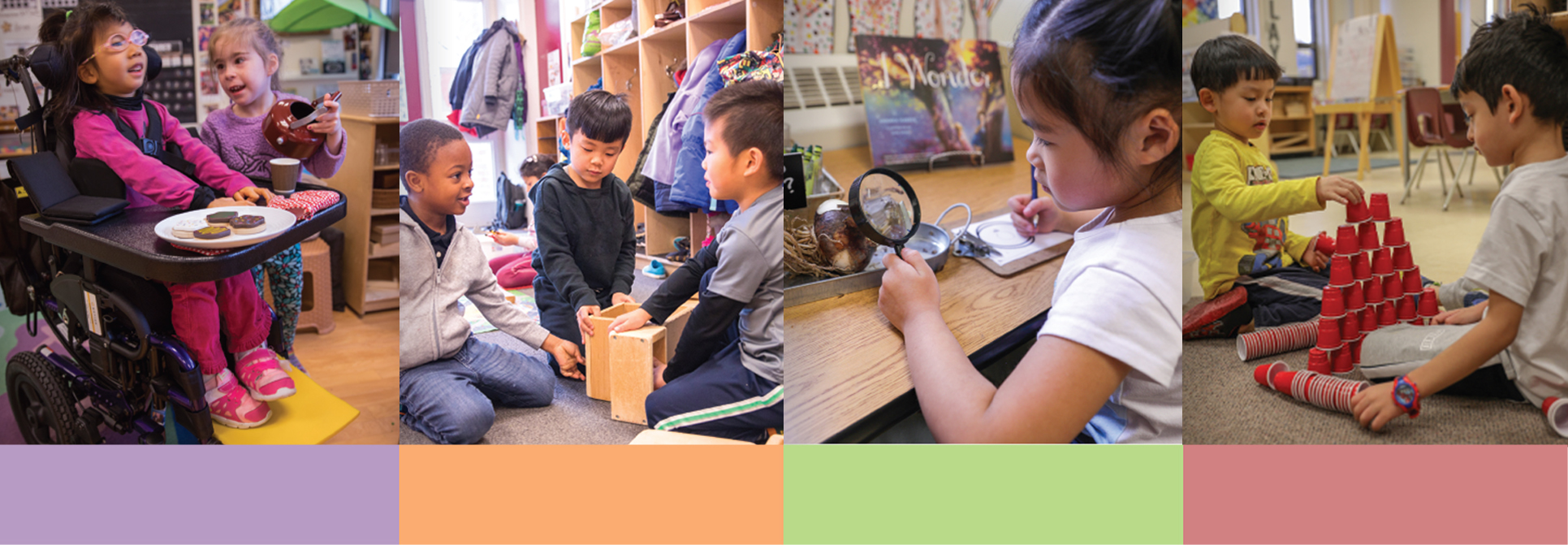
How Do Children Learn Through Play?
In our play-based program, children learn by:
- exploring ideas and language
- using hands-on activities to discover and learn
- experimenting with open-ended materials
- imagining and creating with the arts
These activities help expand their natural creativity, inquiry and imagination as they develop skills like:
- problem-solving
- abstract reasoning
- critical and creative thinking
- collaboration
- communication
Educators guide and support children as they explore, laying the foundation for literacy, math, and lifelong learning.
Meet the Educator Team
Each Kindergarten class has a teacher and a Designated Early Childhood Educator (DECE) working together. They bring complementary skills to create a nurturing and fun space that meets the unique needs of each child.
Play, Learn, Thrive: Welcome to Kindergarten

Learning Together
In Kindergarten, we focus on four key areas for learning:
- Belonging and Contributing: Building connections with others and understanding the world around them.
- Self-Regulation and Well-Being: Learning to manage emotions and care for themselves.
- Demonstrating Literacy and Mathematics Behaviours Skills: Early reading, writing, numeracy and problem-solving.
- Problem-Solving and Innovating: Developing creativity and critical thinking through hands-on activities.
Belonging and Contributing focuses on children’s:
- sense of connectedness to others
- ability to form relationships and make contributions as part of a group, a community, and the natural world
- developing understanding of how people relate to one another and to the world around them
What children learn within this frame provides them with a sense of being personally connected to various groups and communities. This learning lays the foundation for developing the traits and attitudes required for responsible citizenship.
Self-Regulation and Well-Being focuses on children’s:
- ability to understand their own thoughts and feelings, to see that others may have different thoughts and feelings, and to respect those differences
- ability to understand and manage their emotions and impulses, find ways to deal with distractions, and be aware that their actions have consequences
- awareness of their physical and mental health and wellness
What children learn through this frame allows them to focus, to learn, to respect themselves and others. This learning promotes well-being in themselves and others.
Demonstrating Literacy and Mathematics Behaviours focuses on children’s:
- ability to communicate their thoughts and feelings in various ways, using their bodies, words, symbols, images, constructions, and/or other forms of expression
- “literacy behaviours” - the various ways in which children use language, images, and materials to express ideas and emotions as they respond to words and stories, begin to think critically, and begin to read and write
- “mathematics behaviours” - the various ways in which children use concepts of number and pattern during play and inquiry; process various kinds of information; and begin to grasp mathematical relationships, concepts, skills, and processes
- curiosity about literacy and mathematics and love of learning in general, as they develop the habit of learning for life
What children learn in connection with this frame develops their capacity to think critically, to understand and respect many different perspectives, and to process various kinds of information.
Problem Solving and Innovating focuses on children’s:
- desire to explore the world out of natural curiosity, which develops their minds, their senses, and their bodies
- desire to make meaning of their world by asking questions, testing theories, solving problems, and using creative and analytical thinking
- confidence to explore the innovative thoughts and activities that naturally arise with an active curiosity, and to apply those ideas as they interact with others and with the world
What children learn in connection with this frame will help them develop the habit of applying creative, analytical, and critical-thinking skills in all aspects of their lives.
Family Partnerships
You are an expert on your child and an important part of your child’s education. We believe working closely with families is key to success and encourage you to be involved in your child’s learning.
- Share your child’s interests, strengths, and learning preferences with educators.
- Talk with your child about what they’re learning at school.
- Participate in opportunities for families in the classroom, like curriculum nights.
- Share what your child is learning at home, like drawings, photos or stories.
Access more tips and resources for Kindergarten families.
Supporting Every Child
We welcome and support children of all abilities, backgrounds, and experiences.
If your child has special education needs, we work with families, school staff, and community partners to ensure a smooth transition and successful learning experience.
Learn more about how we work with families to support students with special education needs and Multilingual Language learners.
Daily Routines: What to Know
Arrival and Dismissal
Your school will share specific start and end times, as well as arrival and pick-up routines.
Snacks and Lunches
- Pack healthy, easy-to-open snacks and meals that don’t need heating.
- Consider litterless containers to reduce waste.
- Make sure students can open their containers.
- Preparing lunch the night before can make mornings easier.
Washroom Independence
Children are encouraged to use the washroom and dress independently. Send extra clothes for accidents, and school staff will support children who need help while they adjust.
Personal Belongings
Help your child stay organized by:
- Labeling all personal items with their name.
- Providing a backpack that fits their lunch bag, books and extra clothes.
- Sending a pair of indoor and outdoor shoes.
Food Allergies
To keep everyone safe, we ask families to avoid sending foods that may cause severe allergic reactions. Inform your school if your child has allergies, and they will communicate specific allergy-related guidelines.
Outdoor Learning
Outdoor play is a big part of Kindergarten! Please dress your child for the weather:
- Winter: Send a warm hat, mittens, boots, and a snowsuit.
- Summer: Pack a sun hat, reusable water bottle, and sunglasses with UV protection.
Kindergarten is an exciting time for your child to grow, explore, and learn. We look forward to partnering with you to make this a wonderful experience!
Frequently Asked Questions:
School Environment and Structure
In a Kindergarten classroom, you can expect to see students learning through play, developing important skills and being supported by dedicated and caring Kindergarten educators.
You can learn more about what to expect in Kindergarten, including daily routines on this page.
Each Kindergarten class has a teacher and a Designated Early Childhood Educator (DECE) working together. They bring complementary skills to create a nurturing and fun space that meets the unique needs of each child.
Families can expect class sizes of about 26-29 students with two educators in the class. Every Kindergarten class with 16 or more students has an Ontario Certified Teacher and a Designated Early Childhood Educator, who work collaboratively to support the needs of all the children in the class.
Kindergarten classrooms are warm, welcoming and caring places that reflect children’s diverse cultures, languages, strengths and interests.
In York Region District School Board, we work hard to create safe, welcoming and inclusive learning spaces where students and families feel valued and respected.
Curriculum and Learning
Families can learn more about Kindergarten in Ontario by reading the Ontario Kindergarten curriculum and Growing Success, the Ministry of Education’s assessment policy for Kindergarten
We believe that all children can be successful.
Educators guide and support children as they learn within the play-based learning environment, laying the foundation for literacy, math, and lifelong learning.
Instruction is differentiated across the two-year continuum of the Kindergarten Program to support all children’s entry point and individual stages of development.
Educators will communicate with you throughout the year about your child’s progress.
The learning in Kindergarten is outlined in the Ontario Ministry of Education’s Kindergarten Curriculum, 2026. Kindergarten is a play-based learning model, supported by qualified teachers and DECEs who carefully plan instruction and assessment that is designed to support each child’s learning in the areas of problem solving, language acquisition, literacy, and mathematics, as well as the development of social, physical, and emotional skills.
The Kindergarten curriculum learning expectations are organized into four areas:
- Strand A: Foundations of Language and Mathematics
- Strand B: Problem Solving and Innovating
- Strand C: Self-Regulation and Well-Being
- Strand D: Belonging and Contributing
These strands are delivered through the following instructional approaches:
- Evidence-based explicit and systematic instruction
- Play and inquiry-based learning
- Universal design for learning, differentiated instruction and the tiered support
To learn more about the Kindergarten curriculum, please visit the Kindergarten: An Overview for Parents page from the Ministry of Education.
Behaviour and Emotional Development
We are here to help. Transition to school may look different for each child depending on their previous experiences and unique development.
Our skilled, caring and dedicated educators will work with your family to support your child’s transition to Kindergarten and help make it a positive experience.
There are things that we can all do to benefit mental health:
- Exercise and eat healthy.
- Maintain good sleep habits.
- Practice gratitude and mindfulness.
- Encourage daily face to face time with family and friends.
- Prevent and manage stress when it happens.
If you are worried about your child’s well-being, please reach out to your child’s educators.
You may also find these tips on helping your child prepare for Kindergarten helpful.
Every student has a right to learn in a safe, caring and supportive environment.
The Board has a bullying prevention strategy, and our schools are actively engaged in bullying awareness, intervention and prevention through programs including Restorative Practices, Empowered Student Partnerships, Bullying Awareness and Prevention Week, and more.
Learn more about bullying prevention in the York Region District School Board.
Self Care
School staff will support children who need help. Self-care skills include:
- washing hands
- using the bathroom successfully
- getting dressed
- zipping up a jacket
In the months leading up to Kindergarten, practice these skills together at home. Making the experience playful by making up a step-by-step song, rhyme, or involving games can help make the practice fun and easier to understand.
You may also find these tips on helping your child prepare for Kindergarten helpful
School staff will support children who need help while they adjust to school. We ask all families to send children to school with an extra set of clothes to be kept at school.
School Services and Resources
Every school has a before and after school program, which is listed on your school’s website and in our online child care directory. If you are interested in care, you can reach out to the licensed operator at your child’s school for information about space and registration.
Students bring their own lunches and snacks. Some schools may offer hot lunches, such as pizza lunches, through their school council.
In Kindergarten, we recommend:
- Packing healthy, easy-to-open snacks and meals that don’t need heating.
- Consider using litterless containers to reduce waste.
- Help your child learn how to open their own containers as much as possible.
- Please follow any directions from your child’s school about any foods that cannot be sent in your child’s lunch due to allergies in their class.
- Preparing lunch the night before can make mornings easier.
The York Region District School Board offers a variety of summer learning programs for elementary students.
Social Interactions
Families may wish to play alongside their child and model language for children to use while entering and engaging in play with other children.
Role play is one way to playfully engage with your child to act out social situations they may encounter.
Another way to build friendships could be to explore a nearby park or York Region EarlyON centre where your child can engage with other children.
You can help your child build their social skills by modelling or practicing with your child how to get to know others and maintain friendships. For example: When you are at the park or reading books, invite your child to be a “friendship detective”. Say things like, "Look, that boy is swinging alone, maybe he'd like a turn on the slide with you?" or "See how she held the door? That was being a helper!"
While at school, your child will be actively supported by their classroom educators in building new friendships and developing their social skills during play-based experiences.
Related Content
